Project Background
The Evolution of Eagles Island Nature Park
The effort to preserve Eagles Island has been underway for more than two decades. Conservation efforts began in 2001 when a private donor gave a 52-acre tract of land to the New Hanover Soil & Water Conservation District. Subsequent environmental assessments documented the island’s extraordinary ecological value and helped build support for protecting its extensive wetlands, forests, tidal creeks, and cultural resources. Additional conservation lands were acquired through private donations and public funding.
To better understand the island’s remarkable natural and historical significance, Land Management Group and Environmental Sciences, Inc. collaborated to compile existing research, conduct biological surveys, and document the island’s history. Their landmark publication, Eagles Island: A History of a Landscape (2011), remains one of the most comprehensive references on the island’s ecology, history, and conservation values.
Building upon that foundation, the Eagles Island Coalition—a partnership of public agencies, nonprofit organizations, educators, scientists, and community leaders—was formed to promote a coordinated approach to protecting and interpreting the island’s resources. In 2015, the Coalition completed the Eagles Island Conservation Management Plan, which identified the island’s natural and cultural assets, evaluated threats and opportunities, and established a long-term vision for conservation and public access.
As public interest continued to grow, the Eagles Island Central Park Task Force was established under the leadership of Evans Folds and Lloyd Singleton. The Task Force brought together historians, archaeologists, environmental scientists, planners, educators, conservationists, and community volunteers to develop a shared vision for what would become Eagles Island Nature Park. Their work culminated in the publication of the Eagles Island Vision Book and laid the groundwork for the next phase of the project.
Today, that vision is being carried forward by the Eagles Island Nature Park Board of Directors, a nonprofit 501(c)(3) organization established to transform years of planning into implementation. The Board is focused on conservation, education, heritage preservation, and carefully planned public access while building the partnerships and financial resources necessary to make the vision a reality.
Supporting this effort is Friends of Eagles Island, a growing community of citizens, volunteers, historians, paddlers, conservationists, educators, and supporters who share a common commitment to protecting and celebrating one of southeastern North Carolina’s most extraordinary landscapes. Through educational programs, volunteer opportunities, public presentations, newsletters, and advocacy, Friends of Eagles Island provides a way for the public to participate directly in the long-term stewardship of the island.
Together, the Board of Directors and Friends of Eagles Island are working to create a nationally significant nature park where conservation, history, recreation, and education come together. The vision is to preserve Eagles Island’s unique landscape while providing carefully planned opportunities for future generations to experience its rich ecological, cultural, and maritime heritage.
Patchwork of Ownership is a Significant Issue
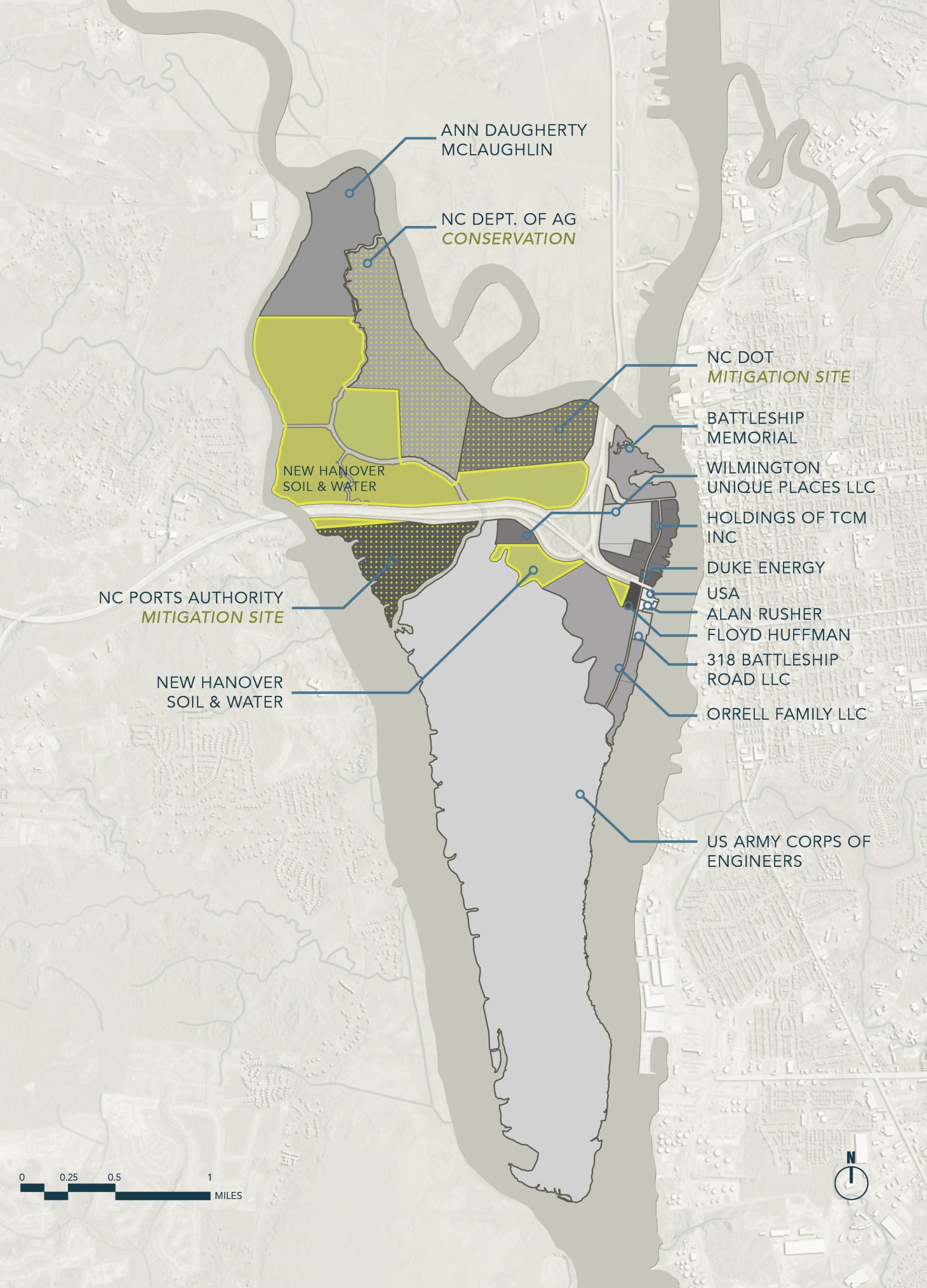
The patchwork of ownership on Eagles Island is a significant constraint concerning the establishment of Eagles Island Nature Park. The division of parcels on the Island represents a vast array of public and private ownership conditions and varying degrees of land use and management. Six parcels, representing approximately 520 acres, are owned and/ or held in conservation easements by the New Hanover Soil & Water Conservation District. These parcels can currently support programming and public access as part of Eagles Island Nature Park but are limited in accessibility due to isolation from existing infrastructure and the prevalence of wetland conditions. Separately, several of the larger parcels on the island, totaling about 485 acres, are owned and/or held in conservation easements by state agencies including the North Carolina Department of Transportation, the North Carolina Department of Agriculture, and the North Carolina Ports Authority. These areas may support the Eagles Island Nature Park programming vision. Therefore, conversations with these state agencies should be initiated to pursue shared-use agreements for public access, if desired. The largest single parcel on Eagles Island is under the jurisdiction of the United States Army Corps of Engineers, and while most of the area is actively used as a dredge spoil storage and disposal area, a shared-use agreement for public access could also be pursued within the northern portion of this parcel.
Lastly, the series of smaller parcels along the eastern shore of Eagles Island is predominantly in private ownership, with some of the land in industrial use. This area has been extensively modified by past and present land uses, and is essentially the only part of the island with soils and elevation suitable for development. As such, there has been ongoing interest in private residential or mixed-use development in the area directly south of the USS North Carolina Battleship Museum.
Ships Graveyard
The shoreline of Eagles Island, directly across from downtown Wilmington, is a “ships graveyard,” with some 37 sunken ships, barges, and other maritime remnants. The ships are included in the National Registry of Historic Places and protected by the federal Abandoned Shipwreck Act of 1987. The vessels are also included in the Historic Wilmington Preservation District.